Formula, line by line
SynoCell Ingredients: The Five Actives in Each Serving
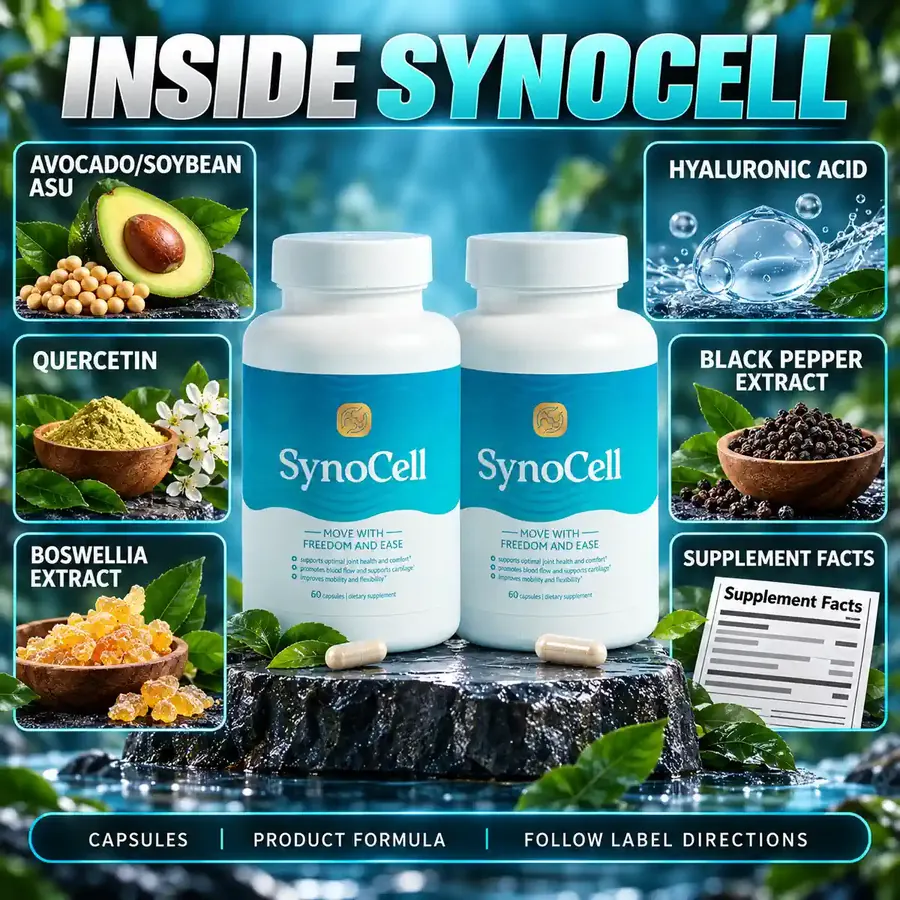
SynoCell has five ingredients, and every amount is printed on the label.
Each 2-capsule serving gives ASU 310 mg, quercetin 310 mg, Boswellia serrata extract 200 mg, hyaluronic acid 180 mg and black pepper extract 5 mg.
To see how they sit on the bottle, read the full Supplement Facts.
Written by the SynoCell editorial teamUpdated
Which five ingredients are in each serving?
Tap a card to see the studied amount and the main caution.
-
01
Avocado/soybean unsaponifiables (ASU)
Persea americana and Glycine max oil fractions
Per serving: 310 mg
Small benefitStudied at300 mg a day (trials up to 3 years)
Watch forMade from soy and avocado: people with soy allergy should ask a clinician first.
Full profile -
02
Quercetin
Plant flavonoid
Per serving: 310 mg
No human joint trialsStudied atUp to 1,000 mg a day in general studies; no human arthritis trials
Watch forCan interact with several drugs, including warfarin, cyclosporine and some antibiotics.
Full profile -
03
Boswellia serrata extract
Boswellia serrata (Indian frankincense)
Per serving: 200 mg
Small trials, positiveStudied at100-250 mg a day of different extracts (5-Loxin, Aflapin)
Watch forUsually well tolerated; ask a doctor first if you take blood thinners.
Full profile -
04
Hyaluronic acid
Sodium hyaluronate (a natural joint-fluid sugar)
Per serving: 180 mg
Small trials, mixedStudied at48-240 mg a day in small oral studies
Watch forSwallowed HA is not the same as HA joint injections; studies are small.
Full profile -
05
Black pepper extract (BioPerine)
Piper nigrum fruit, standardized for piperine
Per serving: 5 mg
Absorption aid, not a joint ingredientStudied at5-30 mg a day in supplements; 15-20 mg in drug-interaction studies
Watch forPiperine can raise blood levels of some medicines. Tell your doctor or pharmacist.
Full profile
Why does a fully printed formula matter?
Because you can check it. Many joint products hide amounts inside a "proprietary blend." SynoCell prints a number next to all five ingredients, which lets you compare each one with research.
The brand store does not publish the other ingredients, the capsule shell, an allergen statement or warnings. Those lines are not published; read your bottle. The full transcription is on the Supplement Facts page.
How do the label amounts compare with research doses?
Two match closely, one is a different extract, and one is well below common supplement use. Click any name for its full profile.
| Ingredient | Per serving | Amount used in research | Evidence |
|---|---|---|---|
| Avocado/Soybean Unsaponifiables (ASU) | 310 mg | 300 mg a day (trials up to 3 years) | Small benefit (Cameron and Chrubasik, 2014) (Maheu et al., 2014 (ERADIAS)) (WebMD, Avocado soy unsaponifiables) |
| Quercetin | 310 mg | Up to 1,000 mg a day in general studies; no human arthritis trials | No human joint trials (MSKCC, Quercetin) (RxList, Quercetin) (Andres et al., 2018) |
| Boswellia extract (Boswellia serrata) gum resin, std. to 65% boswellic acid | 200 mg | 100-250 mg a day of different extracts (5-Loxin, Aflapin) | Small trials, positive (Cameron and Chrubasik, 2014) (Yu et al., 2020) (Sengupta et al., 2008) |
| Hyaluronic acid | 180 mg | 48-240 mg a day in small oral studies | Small trials, mixed (Oe et al., 2016) (Tashiro et al., 2012) (Guadagna et al., 2018) |
| Black Pepper (fruit) Extract (BioPerine) | 5 mg | 5-30 mg a day in supplements; 15-20 mg in drug-interaction studies | Absorption aid, not a joint ingredient (Shoba et al., 1998) (Horn and Hansten, 2017) (Ziegenhagen et al., 2021) |
Daily Value is not established for any of the five. Research amounts come from studies of each ingredient alone, never from a study of SynoCell.
What does ASU bring to the formula?
ASU has the most human joint data of the five. It comes from avocado and soybean oils, and SynoCell lists 310 mg against 300 mg a day in trials. A Cochrane review found a small pain benefit of questionable clinical importance (Cameron and Chrubasik, 2014).
Over 3 years in a hip trial, it did not slow joint-space loss (Maheu et al., 2014 (ERADIAS)). It is made partly from soy, a common allergen (MedlinePlus, Food allergy). Read the full ASU profile.
What do Boswellia and hyaluronic acid add?
Both have small human trials for knee osteoarthritis, with caveats that matter.
Boswellia serrata extract
Standardized to 65% boswellic acids. The positive trials used other extracts: 5-Loxin (30% AKBA) at 100 or 250 mg and Aflapin at 100 mg (Sengupta et al., 2008) (Cameron and Chrubasik, 2014). A meta-analysis of 7 trials was positive, but the trials were small (Yu et al., 2020). More on the Boswellia page.
Hyaluronic acid
Oral studies used 48-240 mg a day, often in mixtures, several linked to manufacturers (Oe et al., 2016). A systematic review found modest, inconsistent objective results (Guadagna et al., 2018). Swallowed HA is not the same as a knee injection.
Try SynoCell with a 90-day window2 capsules a day · from $39 a bottle · free standard U.S. shipping
Order nowWhy are quercetin and black pepper extract included?
Quercetin is sold as an antioxidant, and black pepper extract is an absorption aid. Neither has human evidence for joints.
Quercetin
A plant pigment from foods like onions and apples. Its osteoarthritis data come from animals and lab dishes only (MSKCC, Quercetin). It can interact with several medicines, including warfarin and cyclosporine (RxList, Quercetin).
Black pepper extract
Sold as BioPerine, it supplies piperine, which can raise how much of a compound gets into the blood (Shoba et al., 1998). Germany's risk agency derived a guidance value of about 2.3 mg a day, and 5 mg is above it (Ziegenhagen et al., 2021).
How strong is the evidence compared with exercise and weight loss?
Much weaker. Exercise and weight loss sit at the top of the ladder, with strong guideline support. The SynoCell ingredients fall in the small-effect zone, and quercetin sits near the bottom (ACR, 2026 OA guideline summary).
Exercise
StrongStrongly recommended by the American College of Rheumatology for knee, hip and hand osteoarthritis. (ACR, 2026 OA guideline summary) (Kolasinski et al., 2020 (ACR/AF 2019 guideline))
Weight loss (if overweight)
StrongEach pound lost takes about four pounds of load off the knee; strongly recommended for knee and hip OA. (Messier et al., 2005) (ACR, 2026 OA guideline summary)
Topical or oral NSAIDs
StrongStrongly recommended, with heart, stomach and kidney risks to discuss with a doctor. (ACR, 2026 OA guideline summary) (FDA, 2015 NSAID safety communication)
Avocado/soybean unsaponifiables
SmallFour trials: pain about 8.5 points lower on a 0-100 scale, a benefit of questionable importance. (Cameron and Chrubasik, 2014)
Boswellia extracts
Small trialsSeven small trials, 545 patients, mostly positive; different extracts from SynoCell's. (Yu et al., 2020)
Oral hyaluronic acid
MixedSmall studies; one 12-month trial helped only people aged 70 or younger. (Tashiro et al., 2012) (Guadagna et al., 2018)
Glucosamine and chondroitin
Advised againstThe 2026 ACR guideline strongly recommends against them for knee, hip and hand OA. (ACR, 2026 OA guideline summary)
Quercetin for joints
No human trialsOnly animal and lab data for osteoarthritis. (MSKCC, Quercetin)
Bar length shows how much published evidence supports each option for osteoarthritis pain and function, based on the guideline and reviews linked here. A reading aid, not a score from any one source.
For a fuller comparison of options, see how to choose a joint supplement.
What is not in SynoCell?
There is no glucosamine, chondroitin, collagen or turmeric in the formula. The 2026 American College of Rheumatology guideline strongly recommends against glucosamine, chondroitin and combination products (ACR, 2026 OA guideline summary).
- No proprietary blend: every amount is printed.
- No published list of fillers or capsule material yet.
- No trial of the SynoCell combination itself.
Which ingredients matter most for safety?
Quercetin and black pepper extract, because both can change how some medicines are handled by the body. ASU matters for anyone with a soy allergy. If you take daily prescriptions, bring the bottle to your pharmacist first. Details are on side effects and interactions.
FAQ
Questions about SynoCell ingredients
What is in SynoCell joint support?
Five ingredients per 2 capsules: avocado/soybean unsaponifiables 310 mg, quercetin 310 mg, Boswellia serrata extract 200 mg standardized to 65% boswellic acid, hyaluronic acid 180 mg and black pepper extract (BioPerine) 5 mg. Inactive ingredients and the capsule shell are not published on the brand store.
Does SynoCell contain glucosamine or chondroitin?
No. SynoCell has neither. Its five ingredients are ASU, quercetin, Boswellia, hyaluronic acid and black pepper extract. That matters because the 2026 American College of Rheumatology guideline strongly recommends against glucosamine and chondroitin for knee, hip and hand osteoarthritis.
Does SynoCell contain soy?
Yes, in a sense. ASU is made from avocado and soybean oil fractions. The brand store publishes no allergen statement, so it is unclear how much soy protein remains. If you have a soy allergy, ask your doctor or allergist before taking it.
Is SynoCell a proprietary blend?
No. All five ingredients are listed with their own amount in milligrams, so you can compare each with research doses. What is missing is the list of inactive ingredients and the capsule material, which the brand store has not published.
Which SynoCell ingredient has the best evidence?
ASU and Boswellia have the most human data, both with small benefits for osteoarthritis pain. ASU's Cochrane review found a small effect of questionable importance; Boswellia's trials were small and used different extracts. Neither comes close to the evidence for exercise and weight loss.
Is the hyaluronic acid in SynoCell like a knee injection?
No. SynoCell's 180 mg is swallowed and digested, while injections place hyaluronic acid straight into the joint. The two are studied separately. Oral studies are small with mixed results, and the American College of Rheumatology conditionally recommends against knee injections.
Who wrote this
Written and reviewed by
Plain-language pages built from the label, the brand store and linked medical sources.
Last updated . Read our editorial standards and how we check reviews. This website is run by an authorized U.S. retailer, not by the manufacturer. We earn money when you buy through our order links.
Keep reading
More about SynoCell
Supplement Facts
Every line of the SynoCell label, what is missing from it, and how to read any Supplement Facts panel.
Read moreSide effects
Side effects of each SynoCell ingredient, which medicines to check, warning signs and how to report a problem.
Read more
Choosing a joint supplement
Seven checks to run before you buy any joint supplement, with SynoCell scored line by line.
Read moreUSA authorized SynoCell retailer
Ready to try SynoCell?
Pick a pack. Two capsules a day, and the 90-day money-back policy gives you three months to decide.
- Secure checkout
- 90-day money-back policy
- Ships from the U.S. with tracking