USA authorized SynoCell retailer2 capsules a day · 60 per bottleFree standard U.S. shipping90-day money-back policy
Order now

Benefits, checked

SynoCell Benefits: What It May Do for Your Joints

Quick answer

SynoCell may give a small lift in joint comfort and function.

Two of its ingredients, ASU and Boswellia, showed modest pain benefits in trials, and the SynoCell ASU dose matches the amount studied.

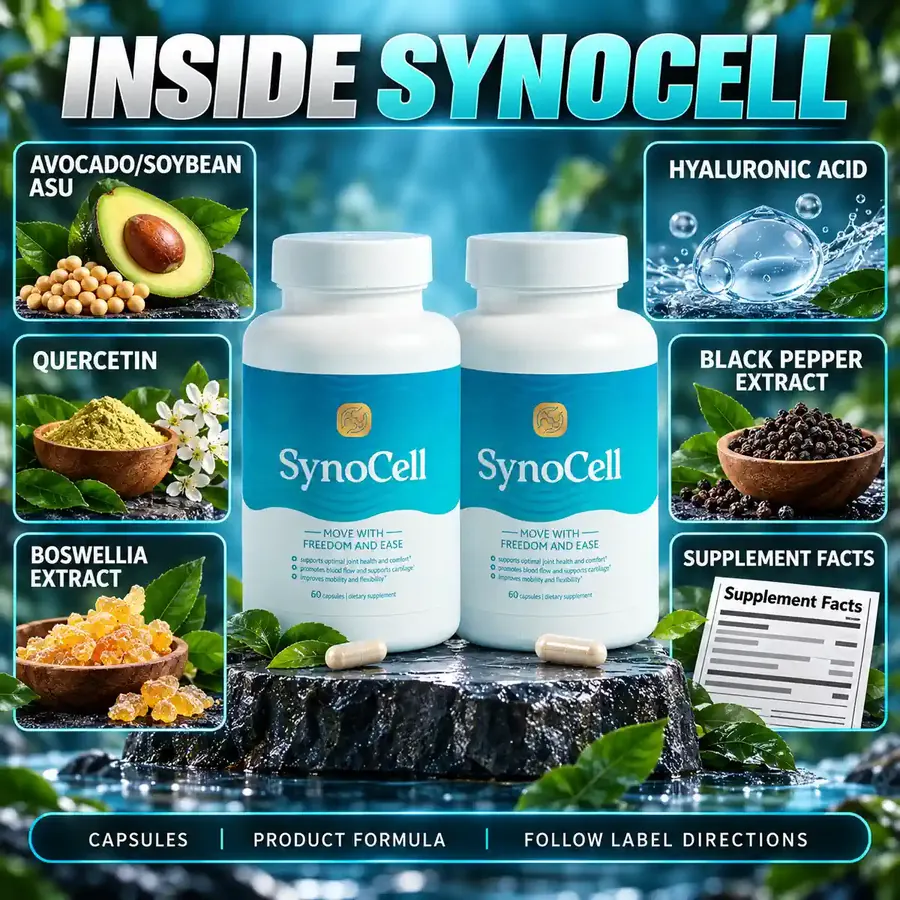
Curious about the formula? Look at all five ingredients.

Written by the SynoCell editorial teamUpdated

Does SynoCell really work for joints?

It might help a little, and that is the honest ceiling. The evidence behind its best ingredients points to small gains in pain and stiffness, not a change in the joint itself.

SynoCell is a dietary supplement, not a drug or an arthritis treatment. We checked each claim from the bottle and the brand store against published human studies, and we say plainly which ones hold up.

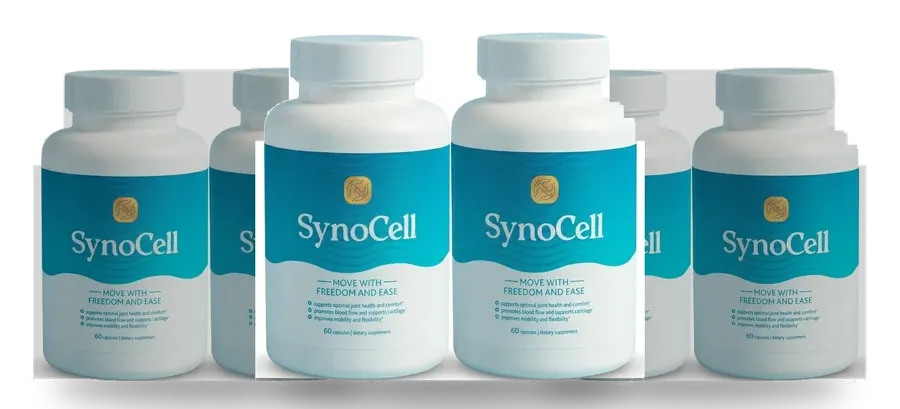
Three white SynoCell bottles in front with more bottles behind, teal wave labels
A 3-bottle order covers 90 days, about the length of the Boswellia trials that showed benefits.

What does the seller claim, and what do studies show?

The four biggest claims, each paired with the closest human evidence. Two hold up in part; two are not shown.

The seller says

Supports optimal joint health and comfort (bottle)

What the evidence shows

ASU and Boswellia showed small pain benefits in trials at similar doses; nobody has tested the SynoCell blend itself. (Cameron and Chrubasik, 2014) (Yu et al., 2020)

Some support
The seller says

Improves mobility and flexibility (bottle)

What the evidence shows

Boswellia trials reported better function scores over about 90 days; oral HA results were mixed. (Yu et al., 2020) (Guadagna et al., 2018)

Small trials only

The seller says

Reduces inflammation and “stops the cytokine storm” (brand store)

What the evidence shows

No human trial of these ingredients measured a “cytokine storm” in arthritis. Quercetin's joint data are animal and lab only. (MSKCC, Quercetin)

Not shown

The seller says

Speeds joint healing and restores cartilage cushioning (brand store)

What the evidence shows

In a 3-year hip trial, ASU did not change average joint-space loss versus placebo. No supplement is shown to rebuild cartilage. (Maheu et al., 2014 (ERADIAS))

Not shown

Claims are quoted from the bottle and the brand store; they are the seller's words, not ours.

Is every SynoCell claim backed by evidence?

No. Of eight claims we found, the joint-comfort and mobility claims have some support. The rest go beyond any human study we could find.

Every SynoCell claim from the bottle and brand store, with where it appears and our verdict based on human studies.
The seller's wordsWhereOur verdict
"Supports optimal joint health and comfort"BottleSome support Small pain benefits for ASU and Boswellia (Cameron and Chrubasik, 2014) (Yu et al., 2020)
"Improves mobility and flexibility"BottleSmall trials Better function scores with Boswellia (Yu et al., 2020)
"Supports cartilage"BottleNot shown ASU did not slow joint-space loss over 3 years (Maheu et al., 2014 (ERADIAS))
"Promotes blood flow"BottleNot tested No study we found measured it for these ingredients
"Reduces inflammation"Brand storeNot shown Not measured as a joint outcome in people
"Stops the cytokine storm"Brand storeNot shown No arthritis trial of these ingredients measured it (MSKCC, Quercetin)
"Speeds joint healing," "lubricates cartilage and restores cushioning"Brand storeNot shown No human trial of these ingredients showed cartilage repair (Maheu et al., 2014 (ERADIAS))
Quercetin helps "regrow strong, new bones"Brand storeNot shown No human osteoarthritis trials of quercetin (MSKCC, Quercetin)

Can SynoCell help with joint comfort?

Possibly, by a small amount. This claim has the most support, from two ingredients.

ASU at 300 mg a day lowered pain by about 8.5 points on a 0 to 100 scale across four trials of 651 people. The Cochrane authors called that a small benefit of questionable clinical importance (Cameron and Chrubasik, 2014). SynoCell's 310 mg is right at that dose.

Boswellia extracts reduced pain and stiffness in a pooled look at 7 trials with 545 patients (Yu et al., 2020). The trials were small and used other extracts than SynoCell's. The NIH's integrative health center sums up ASU and Boswellia as slight improvements that patients might not find meaningful (NCCIH, Osteoarthritis In Depth).

Read more on the ASU and Boswellia profiles.

Does SynoCell improve mobility and flexibility?

The support is thin but real. In a 90-day trial of 75 people, a Boswellia extract cut pain scores by about 40% and 52% at two doses (Sengupta et al., 2008). That trial was small and linked to the extract's maker.

Oral hyaluronic acid adds little certainty. Short studies reported better scores, but objective measures were modest and inconsistent (Guadagna et al., 2018). Quercetin has no human joint trials to add.

Does SynoCell reduce inflammation in the joints?

That is not shown. The brand store says SynoCell "reduces inflammation" and "stops the cytokine storm," but no human arthritis trial of these ingredients measured either. Quercetin, the ingredient most often tied to those words, has only animal and lab data for osteoarthritis (MSKCC, Quercetin).

Try SynoCell with a 90-day window2 capsules a day · from $39 a bottle · free standard U.S. shipping

Order now

Can SynoCell repair cartilage or grow bone?

No study shows that. The brand store claims SynoCell "speeds joint healing," "lubricates cartilage and restores cushioning," and that quercetin helps "regrow strong, new bones." None of that has been shown in people.

The best test is a 3-year hip trial of ASU in 399 people. Average joint-space loss, pain and function did not differ from placebo (Maheu et al., 2014 (ERADIAS)). The bottle's milder line, "supports cartilage," goes further than this evidence.

A hot, red, swollen joint is not a supplement problem. Sudden swelling or joint pain with fever can mean infection and needs urgent care (MedlinePlus, Septic arthritis).

How do SynoCell's ingredients compare with proven care?

They sit well below the options with strong evidence. Exercise and weight loss lead the 2026 American College of Rheumatology guideline (ACR, 2026 OA guideline summary). The ladder shows where each option stands.

  1. Exercise

    Strong

    Strongly recommended by the American College of Rheumatology for knee, hip and hand osteoarthritis. (ACR, 2026 OA guideline summary) (Kolasinski et al., 2020 (ACR/AF 2019 guideline))

  2. Weight loss (if overweight)

    Strong

    Each pound lost takes about four pounds of load off the knee; strongly recommended for knee and hip OA. (Messier et al., 2005) (ACR, 2026 OA guideline summary)

  3. Topical or oral NSAIDs

    Strong

    Strongly recommended, with heart, stomach and kidney risks to discuss with a doctor. (ACR, 2026 OA guideline summary) (FDA, 2015 NSAID safety communication)

  4. Avocado/soybean unsaponifiables

    Small

    Four trials: pain about 8.5 points lower on a 0-100 scale, a benefit of questionable importance. (Cameron and Chrubasik, 2014)

  5. Boswellia extracts

    Small trials

    Seven small trials, 545 patients, mostly positive; different extracts from SynoCell's. (Yu et al., 2020)

  6. Oral hyaluronic acid

    Mixed

    Small studies; one 12-month trial helped only people aged 70 or younger. (Tashiro et al., 2012) (Guadagna et al., 2018)

  7. Glucosamine and chondroitin

    Advised against

    The 2026 ACR guideline strongly recommends against them for knee, hip and hand OA. (ACR, 2026 OA guideline summary)

  8. Quercetin for joints

    No human trials

    Only animal and lab data for osteoarthritis. (MSKCC, Quercetin)

Bar length shows how much published evidence supports each option for osteoarthritis pain and function, based on the guideline and reviews linked here. A reading aid, not a score from any one source.

A supplement can sit beside those basics, never replace them. See our knee pain guide.

What are the fair upsides of SynoCell?

There are real points in its favor, and they deserve a fair hearing.

In its favor

  • Every ingredient amount is printed, with no hidden blend.
  • ASU and hyaluronic acid sit near research doses.
  • It is not a glucosamine or chondroitin product, which the ACR now advises against.
  • A simple 2-capsule daily routine.
  • Free standard shipping in the mainland U.S. and a 90-day money-back policy.

Against it

  • No trial has tested the SynoCell combination.
  • Quercetin has no human joint trials.
  • Quercetin and piperine can interact with some medicines.
  • Several claims go well past the evidence.

How can you tell if SynoCell is working for you?

Measure, do not guess. Score two or three daily tasks before you start.

  • Rate stiffness on getting up, from 0 to 10.
  • Count stairs or minutes walked before your knee complains.
  • Note how often you reach for a pain reliever.

Score again around day 30 and day 60; a Boswellia review suggests at least 4 weeks (Yu et al., 2020). If nothing has moved, use the money-back guarantee before day 90. The results timeline has more on pacing.

Order SynoCell

FAQ

SynoCell benefit questions

Does SynoCell really work?

It may help some people a little. Its ASU and Boswellia showed small pain benefits in trials, and the ASU dose matches. No trial has tested SynoCell itself, and claims about rebuilding cartilage are not shown. Exercise and weight loss have far stronger evidence. (Cameron and Chrubasik, 2014) (Yu et al., 2020) (ACR, 2026 OA guideline summary)

What is SynoCell good for?

SynoCell is sold for joint comfort, mobility and flexibility. The fairest summary is a possible small easing of stiffness and pain from ASU and Boswellia. It is not a pain reliever and not a treatment for arthritis, so keep your doctor's plan in place. (NCCIH, Osteoarthritis In Depth)

Does SynoCell help cartilage grow back?

No human study shows that. In a 3-year trial, ASU at a similar dose did not slow average joint-space loss in the hip compared with placebo. No other SynoCell ingredient has better cartilage evidence in people. (Maheu et al., 2014 (ERADIAS))

Is SynoCell better than glucosamine?

It is a different kind of product. The 2026 ACR guideline strongly recommends against glucosamine and chondroitin. It does not address ASU or Boswellia, which have small positive trials. That is not proof SynoCell works, only a different evidence picture. (ACR, 2026 OA guideline summary)

Does SynoCell help with inflammation?

That has not been shown. The brand store claims it reduces inflammation, but no human arthritis trial of its ingredients measured that. Quercetin's anti-inflammatory reputation rests on animal and lab work for osteoarthritis. (MSKCC, Quercetin)

Who wrote this

Written and reviewed by

Written byThe SynoCell editorial teamSynocell, USA authorized SynoCell retailer

Plain-language pages built from the label, the brand store and linked medical sources.

Medical review byDr. Nehad Soloman, MD, FACR, MD, PhysicianRole: Medical reviewerReview date: October 12, 2026

Last updated . Read our editorial standards and how we check reviews. This website is run by an authorized U.S. retailer, not by the manufacturer. We earn money when you buy through our order links.

USA authorized SynoCell retailer

Ready to try SynoCell?

Pick a pack. Two capsules a day, and the 90-day money-back policy gives you three months to decide.

  • Secure checkout
  • 90-day money-back policy
  • Ships from the U.S. with tracking
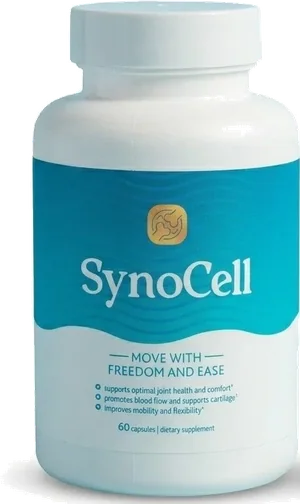
A white bottle of SynoCell capsules with a teal label

SynoCell capsulesFrom $39 a bottle · free standard U.S. shipping · 90-day window

Order now