Buyer's guide
How to choose a joint supplement: a 7-point buyer's checklist
Look for every amount printed, doses close to research, the same extract that was studied, a clear interaction warning, independent testing, no disease claims and written refund terms. SynoCell passes on printed amounts, two near-research doses and a written refund policy. It falls short on testing proof, a published warning and some claims.
Written by the SynoCell editorial teamUpdated
What should you check before buying a joint supplement?
Check the label before the marketing.
Are all the amounts printed?
Each ingredient shows its own amount.
Is the dose close to the research?
Compare it with the dose trials used.
Is it the same extract?
One branded extract's study does not cover another.
Does it fit your medicines?
Some ingredients change how drugs work.
Has anyone outside tested it?
A named lab beats a generic badge.
Are the claims honest?
Disease promises are a warning sign.
Can you get your money back?
Written terms and a phone number protect you.
The FTC asks sellers the same: ingredient studies count only at a comparable dose and form (FTC, Health Products Compliance Guidance).
Why do printed amounts beat a proprietary blend?
Printed amounts let you check the dose; a proprietary blend hides it behind one total weight. Treat a blend's doses as unknown.
All five actives carry their own amount per 2-capsule serving (SynoCell, product page). That is a real point in its favor. See the SynoCell Supplement Facts.
One gap: the other ingredients, capsule shell and allergens are not published. Read your bottle.
Is the dose close to what research used?
For two of SynoCell's ingredients, yes. ASU sits at 310 mg against 300 mg a day in trials (Cameron and Chrubasik, 2014). Hyaluronic acid at 180 mg is inside the 48 to 240 mg range of small studies (Oe et al., 2016).
Quercetin is another story: supplements often give up to 1,000 mg a day (Andres et al., 2018), and it has no human osteoarthritis trials (MSKCC, Quercetin).
A matching dose is the minimum, not a promise: ASU's benefit in trials was small (Cameron and Chrubasik, 2014).
Is it the same extract that was studied?
Two products can both say "Boswellia" and contain quite different extracts.
SynoCell's Boswellia is standardized to 65% boswellic acids. The positive trials used branded extracts: 5-Loxin, standardized to 30% AKBA, at 100 or 250 mg, and Aflapin at 100 mg (Sengupta et al., 2008) (Cameron and Chrubasik, 2014). So those results are a rough guide at best.
- No trial has tested the SynoCell combination itself. More on the Boswellia page.
Could a joint supplement interact with your medicines?
Yes. Quercetin is listed with moderate interactions, including quinolone antibiotics, cyclosporine, blood pressure medicines and warfarin (RxList, Quercetin). Piperine from black pepper raised blood levels of several drugs in small studies at 15 to 20 mg a day (Horn and Hansten, 2017).
SynoCell has 5 mg of piperine. Nobody has studied that amount's effect on your medicines, so ask your pharmacist if the questions below flag you.
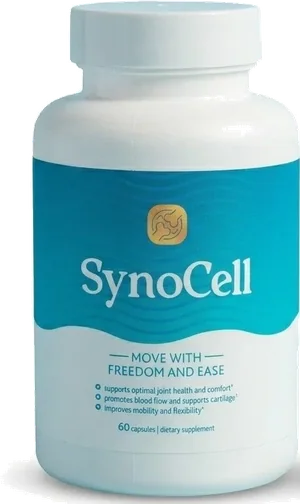
Try SynoCell with a 90-day window2 capsules a day · from $39 a bottle · free standard U.S. shipping
Order nowHow can you tell if a supplement was tested by a third party?
Look for a named lab or a certificate of analysis tied to your lot number. The FDA does not approve supplements before sale (FDA, Questions and Answers on Dietary Supplements), so a badge without a named certifier proves little.
Its brand graphics show a GMP seal and a "Registered FDA Facility" roundel, but neither names a certifier or a facility. The seller's lot and CoA numbers are reference codes, not lab proof. See testing and quality.
Which joint supplement claims are red flags?
Any promise to fix a disease is a red flag. A product sold to treat a disease is regulated as a drug (FDA, Questions and Answers on Dietary Supplements).
Promises of new joint tissue
In a 3-year hip trial, ASU did not change joint-space loss versus placebo (Maheu et al., 2014 (ERADIAS)).
"Backed by science" with no trial named
Ask which trial, which product and which dose.
Big star counts and glowing quotes
Testimonials are not evidence (FTC, Health Products Compliance Guidance), and fake reviews are banned (FTC, Final rule on fake reviews, 2024).
SynoCell's bottle wording is milder, though "supports cartilage" goes past the evidence. The brand store says the product "stops the cytokine storm", "speeds joint healing" and "lubricates cartilage and restores cushioning". Those are seller claims the evidence does not show.
What refund terms should a joint supplement have?
Look for a window long enough to judge results. A Boswellia review suggests at least 4 weeks of use (Yu et al., 2020), so 30 days is tight.
SynoCell's brand policy offers a 90-day money-back guarantee (SynoCell, shipping and refund policy). On multi-packs only one opened bottle is refunded, and U.S. returns lose about 10% for shipping.
For orders placed through this site, call +1 (302) 200-3480 with your order ID. Read the refund policy.
How does SynoCell score on the checklist?
Strong on transparency, weak on proof. We earn money when you buy through our links, so check our work.
| Check | What we found | Result |
|---|---|---|
| Printed amounts | All five actives listed with their own amounts (SynoCell, product page) | Pass |
| Dose near research | ASU and hyaluronic acid close to trial doses; quercetin has no human joint trials (MSKCC, Quercetin) | Partly |
| Same extract as studied | Boswellia at 65% boswellic acids, unlike 5-Loxin or Aflapin (Sengupta et al., 2008) (Cameron and Chrubasik, 2014) | No |
| Interaction warning | Not published on the brand store; read your bottle | Gap |
| Third-party testing | No named lab, no published certificate; badges name no certifier | Not shown |
| Honest claims | Bottle wording is milder; "supports cartilage" and several brand store claims go beyond the evidence | Mixed |
| Refund terms | Written 90-day policy with conditions (SynoCell, shipping and refund policy) | Pass |
In short: open about its doses, unproven as a blend. Exercise still does more for knee and hip osteoarthritis than any capsule (ACR, 2026 OA guideline summary).
FAQ
Questions people ask when comparing joint supplements
What should I look for in a joint supplement?
Look for every ingredient amount printed on its own line, doses near those used in trials, the same extract that was studied, a clear interaction warning, a named testing lab and written refund terms. Skip products that make disease promises.
What is a proprietary blend on a supplement label?
A proprietary blend lists several ingredients under one total weight without saying how much of each is inside. That makes it impossible to compare with research doses. SynoCell does not use one: each of its five actives has its own printed amount per 2-capsule serving.
Are glucosamine and chondroitin worth buying for knee pain?
Probably not. The 2026 American College of Rheumatology guideline summary strongly recommends against glucosamine, chondroitin and combination products for knee, hip and hand osteoarthritis (ACR, 2026 OA guideline summary). SynoCell contains neither. The guideline does not address its ASU or Boswellia, and its hyaluronic acid is swallowed, not injected.
How can I tell if a supplement is third-party tested?
Look for an outside lab's name, a certificate of analysis that matches the lot number on your bottle, or a seal from an independent testing program. A generic GMP badge without a named certifier does not prove testing.
Does SynoCell have an independent testing seal?
Not that we can find. Its brand graphics show a GMP seal and a registered facility roundel, but neither names a certifier. The seller's lot and CoA codes are reference numbers, and no certificate of analysis is published.
Is a money-back guarantee a sign that a supplement works?
No. A guarantee is a purchase policy that limits your risk, not evidence of results. Check how long the window is, what happens to opened bottles, who pays return shipping and which phone number handles refunds before you order.
Who wrote this
Written and reviewed by
Plain-language pages built from the label, the brand store and linked medical sources.
Last updated . Read our editorial standards and how we check reviews. This website is run by an authorized U.S. retailer, not by the manufacturer. We earn money when you buy through our order links.
Keep reading
More about SynoCell
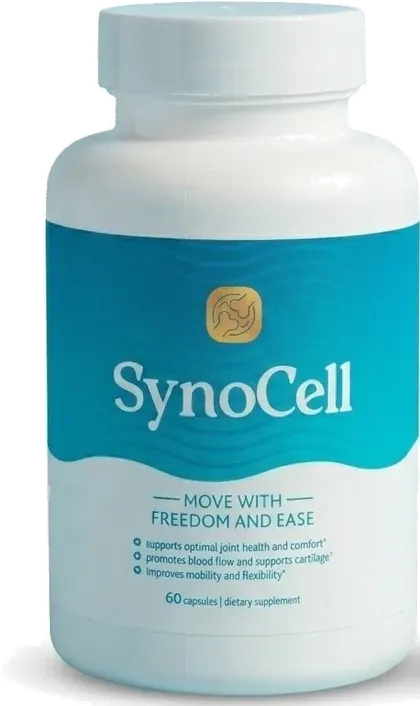
Supplement Facts
Every line of the SynoCell label, what is missing from it, and how to read any Supplement Facts panel.
Read more
Testing & quality
The GMP and FDA facility badges explained, why no CoA is published, and what to ask before you buy.
Read moreHow to read a joint supplement label
Serving size, blends, research doses, standardized extracts and red-flag claims, using the SynoCell panel as the example.
Read moreUSA authorized SynoCell retailer
Ready to try SynoCell?
Pick a pack. Two capsules a day, and the 90-day money-back policy gives you three months to decide.
- Secure checkout
- 90-day money-back policy
- Ships from the U.S. with tracking