Guide · Labels
How to read a joint supplement label
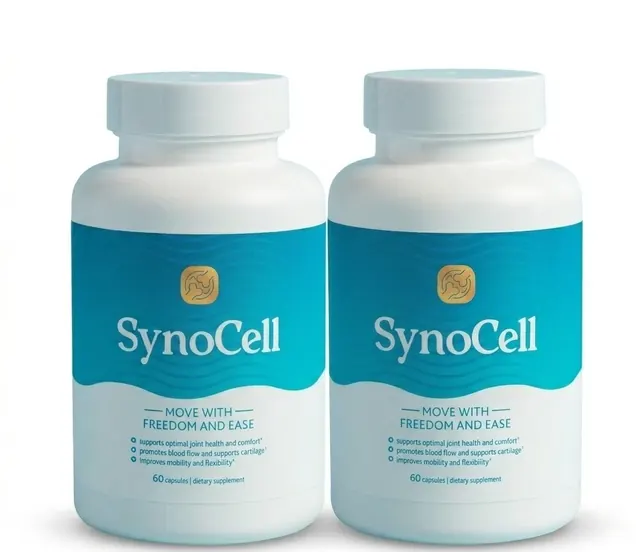
Start with the serving size, then check that every ingredient has its own amount in mg. Compare each amount with the dose used in research, and check whether extracts match the studied form. Treat disease claims as a red flag. SynoCell prints all five amounts, and two sit near research doses.
Written by the SynoCell editorial teamUpdated · 8 min read
The basics
What does a Supplement Facts panel tell you?
A Supplement Facts panel tells you how much of each ingredient you swallow in one serving. The rest of the bottle is marketing until the panel backs it up.
| Part of the panel | What it tells you | SynoCell |
|---|---|---|
| Serving size | How many capsules make one dose | 2 capsules (SynoCell, product page) |
| Servings per container | How many days a bottle lasts at one serving a day | 30 |
| Amount per serving | Milligrams of each ingredient in that serving | Five amounts, from 310 mg down to 5 mg |
| % Daily Value | Share of an official daily target, if one exists | Not established for any of the five |
| Other ingredients | Fillers, capsule shell, flow agents | Not published |
Amounts are per serving: 310 mg under a 2-capsule serving is about 155 mg a capsule.
Worked example
How does the SynoCell panel read, line by line?
Five named ingredients, each with a printed amount, under a 2-capsule serving. Tap a line to see what it means.
Supplement Facts
Serving size 2 capsules · Servings per container 30
One serving is two capsules. The bottle holds 60, so it lasts 30 days.
Thirty days at one serving a day.
Close to the 300 mg used in trials; small pain benefit in reviews.
A plant flavonoid. No human osteoarthritis trials; can interact with some drugs.
Resin extract. Trials used other extracts at 100-250 mg.
Near the 200 mg used in a 12-month oral trial. Not the same as an injection.
Piperine helps absorption and can raise levels of some medicines.
There is no official daily amount for any of these five ingredients.
Typed from the brand store's Supplement Facts (SynoCell, product page). Check the panel on your bottle.
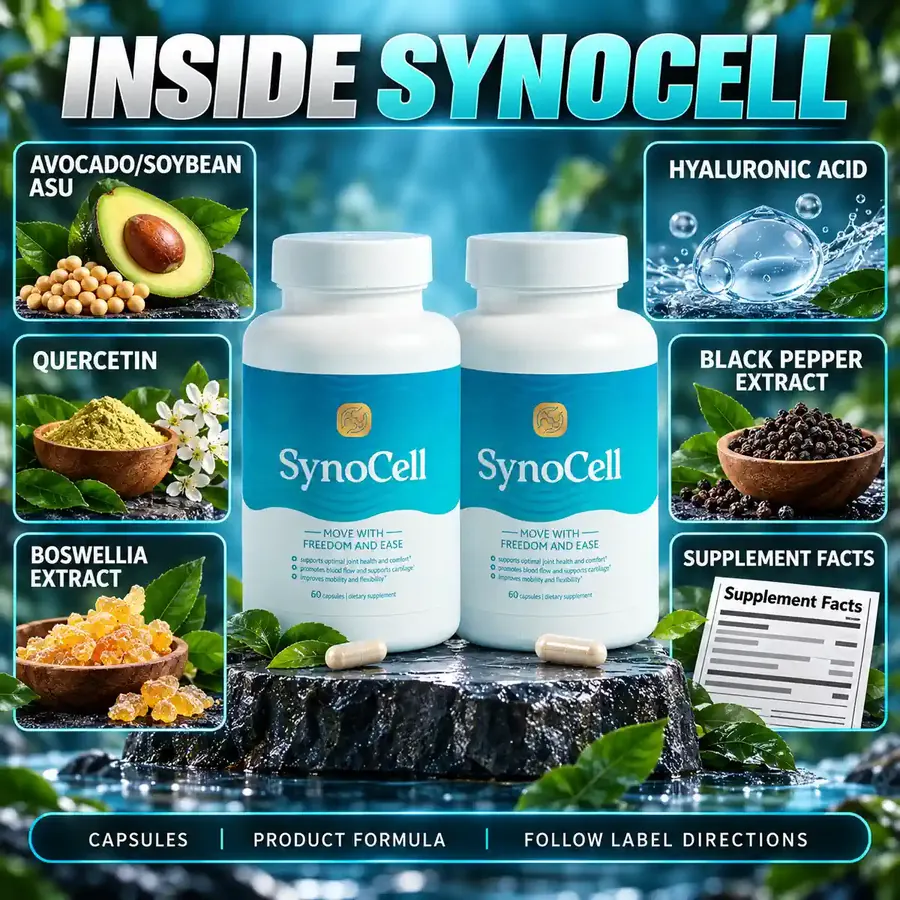
Tap a line of the panel to see what it means. The brand graphic pictures all five ingredients.
Blends
Why does a proprietary blend make a label harder to judge?
A proprietary blend lists a total weight for a group of ingredients but not the amount of each one. You cannot tell whether the star ingredient is 300 mg or 3 mg.
Research is dose-specific. The FTC expects health claims to rest on trials at a comparable dose and form (FTC, Health Products Compliance Guidance), and a blend makes that check impossible.
SynoCell uses no blend: all five amounts are printed, a real point in its favor.
Dose check
How do you compare a label dose with the research dose?
Find the amount used in human trials and set it beside the label. Close is good; far below is a warning sign; no human trials means no judgment is possible.
| Ingredient | Label | Research | Verdict |
|---|---|---|---|
| ASU | 310 mg | 300 mg a day (Cameron and Chrubasik, 2014) | Matches; small benefit |
| Hyaluronic acid | 180 mg | 48-240 mg a day (Oe et al., 2016) | Within range; mixed results |
| Boswellia extract | 200 mg | 100-250 mg of other extracts (Sengupta et al., 2008) | Different extract |
| Quercetin | 310 mg | No human joint trials (MSKCC, Quercetin) | Cannot be judged |
| Black pepper extract | 5 mg | Absorption aid, not a joint dose (Ziegenhagen et al., 2021) | Not a joint ingredient |
A matching dose only means the ingredient was tested. No trial has tested the SynoCell combination itself. See each ingredient in detail on the ingredients overview.
Extracts
What does standardized to 65% boswellic acid mean?
Each batch is adjusted so boswellic acids make up 65% of the extract, about 130 mg in 200 mg.
Standardization helps because plants vary by harvest. But two standardized extracts are not automatically the same. The 5-Loxin extract in a 75-person trial was standardized to 30% AKBA, one specific boswellic acid (Sengupta et al., 2008). A 65% total boswellic acid figure does not tell you how much AKBA is inside.
Does this extract match the one used in the trial, by name or by the same marker compound? If not, the trial supports the plant, not this product. A 2020 meta-analysis of 7 trials with 545 patients found benefits, but the trials were small and used different extracts (Yu et al., 2020). More on the Boswellia page.
Try SynoCell with a 90-day window2 capsules a day · from $39 a bottle · free standard U.S. shipping
Order nowFootnotes
Why does the label say Daily Value not established?
Because no official daily target exists for ASU, quercetin, Boswellia, hyaluronic acid or piperine. Daily Values cover nutrients such as vitamin C, not botanicals.
The double asterisk is a normal footnote, not a warning. It just means the research comparison matters more than a percentage.
Some ingredients have a safety reference instead. For piperine, Germany's risk agency derived a guidance value of about 2.3 mg a day. Australia sets a limit of 10 mg and Health Canada 14 mg (Ziegenhagen et al., 2021). SynoCell's 5 mg sits between them, so ask a pharmacist if you take daily medicines. Read more on the black pepper extract page.
Claims
Which label claims should make you suspicious?
A disease claim is the biggest red flag. Products marketed to treat or prevent a disease are regulated as drugs, and supplements must carry a disclaimer saying their statements have not been evaluated by FDA (FDA, Questions and Answers on Dietary Supplements).
- Disease words: promises to end arthritis or replace surgery.
- Regulatory dressing: a facility badge presented as government approval. FDA does not approve supplements (NIH ODS, Dietary Supplements: What You Need to Know).
- Unnamed seals: no certifier or report behind them.
- Testimonials as proof: stories are not evidence, according to the FTC (FTC, Health Products Compliance Guidance).
- Biology the trials never measured: cartilage regrowth, bone rebuilding, immune storms.
SynoCell's bottle keeps to structure and function wording, such as supports joint comfort and improves mobility. Its brand store goes further. It says the formula stops the cytokine storm and that quercetin helps regrow strong, new bones. Those are the seller's words, and no human trial of these ingredients shows either one.
What is missing
What should you do when a label leaves things out?
Note the gaps and ask the seller before you buy. A missing line is a question, not proof of a problem.
| Other ingredients | Not published |
|---|---|
| Capsule shell (gelatin or plant) | Not published |
| Allergen statement | Not published; ASU comes from soy (MedlinePlus, Food allergy) |
| Warnings and storage | Not published |
| Country of manufacture | Not published |
Your own bottle may say more. For SynoCell, email [email protected] with questions. See the full panel on our Supplement Facts page.
FAQ
Label questions people ask
How do you read a Supplement Facts label?
Start with the serving size, because every amount below it applies to that serving. Then read each ingredient and its amount in mg. Then compare the key amounts with doses used in human trials before trusting any claim.
What is a proprietary blend in supplements?
It is a group of ingredients listed under one total weight, without the amount of each. You cannot tell how much of any single ingredient you get, so you cannot compare it with research. SynoCell does not use one; all five amounts are printed.
What does standardized extract mean on a supplement?
It means each batch is adjusted to contain a set percentage of a marker compound, such as 65% boswellic acids. It improves consistency but does not guarantee the extract matches the one used in trials, which may be standardized to a different compound.
Why do supplements say Daily Value not established?
No official daily target exists for most botanicals and specialty compounds, so the panel cannot show a percentage. It is a normal footnote, not a safety warning. Compare the amount with doses used in human studies instead.
What does the asterisk on a supplement label mean?
A single dagger or asterisk usually points to the FDA disclaimer: the statement has not been evaluated by FDA and the product is not meant to diagnose, treat, cure or prevent disease. A double asterisk often means no Daily Value exists.
Why can't I find SynoCell's inactive ingredients?
The brand store has not published them, along with the capsule shell type, allergen statement and warnings. Check the label on your bottle, which may list more. You can also email [email protected] before ordering if you have allergies or dietary limits.
Who wrote this
Written and reviewed by
Plain-language pages built from the label, the brand store and linked medical sources.
Last updated . Read our editorial standards and how we check reviews. This website is run by an authorized U.S. retailer, not by the manufacturer. We earn money when you buy through our order links.
Keep reading
More about SynoCell
Supplement Facts
Every line of the SynoCell label, what is missing from it, and how to read any Supplement Facts panel.
Read more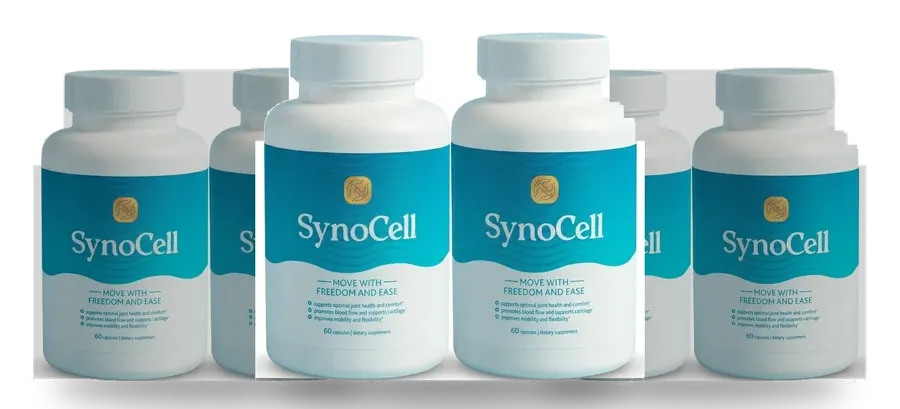
Choosing a joint supplement
Seven checks to run before you buy any joint supplement, with SynoCell scored line by line.
Read moreIngredients
All five ingredients, the amount in each serving, and how much human evidence backs each one.
Read moreUSA authorized SynoCell retailer
Ready to try SynoCell?
Pick a pack. Two capsules a day, and the 90-day money-back policy gives you three months to decide.
- Secure checkout
- 90-day money-back policy
- Ships from the U.S. with tracking