Step by step · Results
Does SynoCell Work for Joint and Knee Pain? 5 Steps to Test It Yourself
It might help a little, and that is the honest ceiling. ASU and Boswellia showed small pain benefits in trials of their own, but no trial has tested SynoCell itself, and no study shows that it rebuilds cartilage. Run a written test for 4 to 8 weeks and decide by about day 75.
Written by the SynoCell editorial teamMedically reviewed by Dr. Nehad Soloman, MD, FACR, PhysicianReviewed · Updated · 8 min read
Key facts
- SynoCell is sold for joint comfort, mobility and flexibility. As a dietary supplement it is no drug and no arthritis treatment.
- No trial has tested SynoCell. Studies looked at its ingredients one at a time.
- In ASU trials, pain came out about 8.5 points lower on a 0-100 scale, a small gain of doubtful importance.
- A review of 7 Boswellia trials with 545 patients was positive, but those extracts differ from SynoCell's.
- No study shows that ASU, hyaluronic acid or any other SynoCell ingredient rebuilds cartilage in people.
- The brand gives no timeline. A Boswellia review points to at least 4 weeks.
- The 90-day money-back window gives your test a deadline. It protects the purchase, and it promises nothing about results.
Step 1: What is SynoCell meant to do?
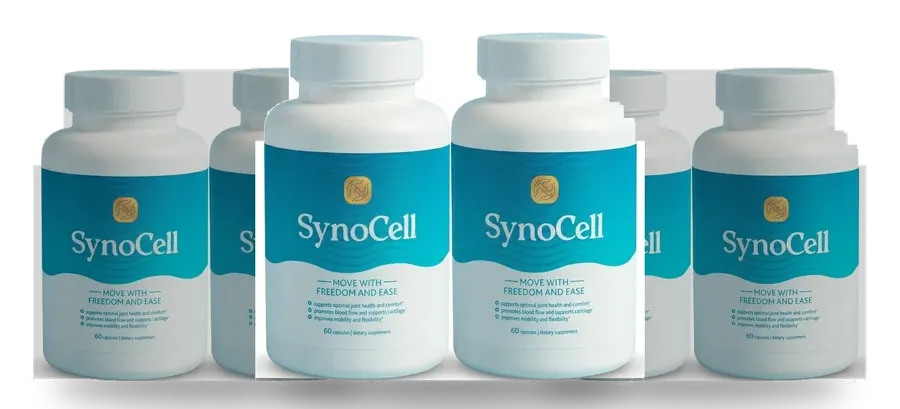
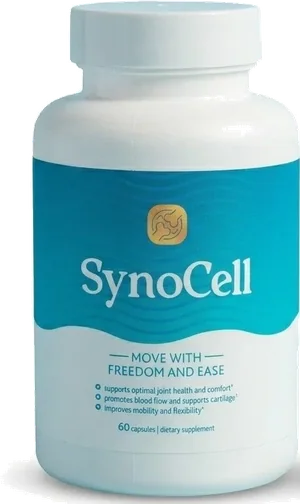
Read the bottle's promises first. Three claims sit on the front: it supports optimal joint health and comfort, it promotes blood flow and supports cartilage, and it improves mobility and flexibility. The slogan under the name is Move with freedom and ease. People find it by typing joint pain, knee pain, back and neck support or arthritis.
Be clear about what those words are. They are structure and function claims, which need no FDA review. SynoCell is a dietary supplement. It is no drug, no pain reliever and no arthritis treatment, and nothing on the label says it can diagnose, treat, cure or prevent a disease.
Also note which joints were studied. The research behind these ingredients looks mostly at knees, with some work on hips. We found nothing on back or neck pain, so a claim aimed at those areas has no study we can point to.
Step 2: What do the ingredient studies actually show?
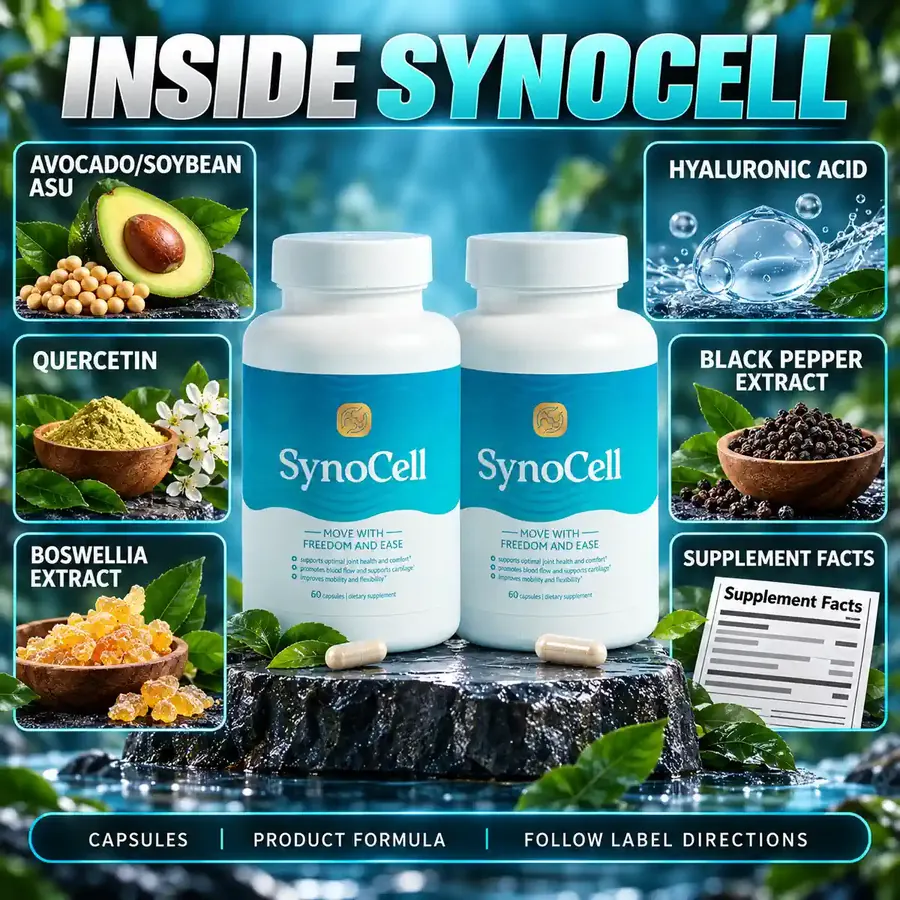
Take the parts one by one. Nobody has tested the five together, so this is the closest evidence there is.
| Ingredient | Findings | Label amount |
|---|---|---|
| ASU | Four trials, 651 people: pain about 8.5 points lower on a 0-100 scale, with no change in joint space | 310 mg |
| Boswellia extract | Seven small trials, 545 patients, mostly positive, using other extracts | 200 mg |
| Hyaluronic acid | Small oral studies at 48-240 mg a day gave mixed results; a 12-month trial helped only people aged 70 or younger | 180 mg |
| Quercetin | No human joint trials; only animal and lab data | 310 mg |
| Black pepper extract | Meant to help absorption; not a joint ingredient | 5 mg |
The authors of the ASU review called the gain small and of questionable clinical importance (Cameron and Chrubasik, 2014). The Boswellia meta-analysis found less pain and stiffness, while noting small trials and different extracts (Yu et al., 2020). The NIH's complementary health center sums up ASU and Boswellia as slight improvements that patients might not find meaningful (NCCIH, Osteoarthritis In Depth).
Step 3: Can SynoCell rebuild cartilage or treat arthritis?
No study shows that. The longest test is the 3-year ERADIAS trial, which gave ASU at 300 mg a day to 399 people with hip osteoarthritis. Joint-space loss, pain and function finished no different from placebo. Fewer people on ASU counted as progressors, 40% against 50%, but the authors say it is unclear what that means in practice (Maheu et al., 2014 (ERADIAS)).
The brand store goes beyond the bottle. It speaks of speeding joint healing, restoring cushioning and regrowing bone. Those are seller's words. No human trial of these ingredients shows any of it, and quercetin has no human joint trials (MSKCC, Quercetin).
SynoCell is not meant for rheumatoid arthritis either. The trials behind these ingredients studied osteoarthritis, the wear-related kind. Rheumatoid arthritis is an immune condition, and it calls for a doctor's diagnosis and prescribed treatment.
Not a supplement problem
A joint that turns hot, red and swollen out of the blue, or joint pain with fever, may be an infection and needs care the same day (MedlinePlus, Septic arthritis).
If you want to test it yourself, a clear plan and a 90-day window make the trial fair. The order page shows both.3 bottles $147 cover 90 days. Free standard shipping in the mainland U.S. We earn money when you buy through our order links.
See today's price and guaranteeStep 4: How do you set up a before and after test?
Record a starting point before the first capsule. Numbers help here and photos of knees do not. Choose five things and check them on set days.
| Check-in | What to write down |
|---|---|
| Day 1 | Minutes of morning stiffness, stair pain from 0 to 10, standing up from a chair (easy, okay, hard), longest walk in minutes, weight, current exercise and medicines |
| Day 14 | The same five checks, plus any new activity or weather change |
| Day 30 | The same checks, and your weight now |
| Day 60 | The same checks, and any side effects |
| Day 75 | Your decision: keep going, stop, or ask for a refund |
Morning stiffness from osteoarthritis typically lasts under 30 minutes (NIAMS, Osteoarthritis). Stiffness that goes on much longer is worth mentioning to your doctor, since it can point to another type of arthritis.
Step 5: How long before you judge, and what counts as a result?
Allow 4 to 8 weeks of steady daily use. A Boswellia review suggests at least 4 weeks (Yu et al., 2020), and the best-known Boswellia trial ran for 90 days (Sengupta et al., 2008). One week says nothing about joints.
What counts as a result? A steady small gain across several of your five checks. A single good day does not count. A realistic win is a slightly easier morning, or a walk that stiffens a little less. A new knee is not a realistic win.
Ask what else changed. Exercise alone can move the needle: placebo takers in the 12-month hyaluronic acid trial improved after daily thigh exercises (Tashiro et al., 2012). Four pounds of knee load disappear with each pound of body weight you lose (Messier et al., 2005). If you began walking and lost weight in the same month, those changes deserve the credit.
Decide by about day 75. That leaves time to call the order desk at +1 (302) 200-3480, mail the bottles and have the return land before day 90.
Is SynoCell worth it, and what is better than SynoCell?
At $59, $49 or $39 a bottle, SynoCell costs about $1.97, $1.63 or $1.30 a day. Whether that is worth it depends on your expectations. You get five ingredients with printed amounts, two of them near trial doses, and the trial results were modest.
Other products do not give a cleaner answer. Any joint supplement is judged the same way: label, dose, research and refund terms. And the steps with the strongest backing are not supplements. The 2026 ACR guideline summary strongly recommends exercise, weight loss for knee and hip arthritis with overweight, and NSAID creams or pills (ACR, 2026 OA guideline summary). Oral NSAIDs carry heart attack and stroke risks (FDA, 2015 NSAID safety communication).
The fair order, then, is movement and weight care first, your doctor's advice on medicines second, and a supplement last if you want one. Our knee pain guide has the ranked list.
FAQ
Frequently asked questions
Does SynoCell really work?
It may help some people a little. ASU and Boswellia showed small pain benefits in trials of their own, and the ASU amount matches the trial dose. SynoCell itself has not been tested, and the idea that it rebuilds cartilage is unproven. Exercise and weight loss rest on far stronger evidence.
Does SynoCell work for knee pain?
Nobody has tested SynoCell for knee pain. Its ingredients were studied mostly in knee osteoarthritis, with small or mixed results. Hope for modest help at best, and only in some people.
How long does it take to see an effect from SynoCell?
There is no published answer for SynoCell itself. The Boswellia review points to 4 weeks as a minimum (Yu et al., 2020). Log your joints for 4 to 8 weeks, then make your call around day 75.
Can SynoCell grow cartilage back?
No study shows that. In the 3-year ERADIAS trial, ASU did not slow joint-space loss compared with placebo (Maheu et al., 2014 (ERADIAS)). The brand store's lines about restoring cushioning are the seller's words, not trial findings.
What is SynoCell used for?
It is sold for joint comfort, mobility and flexibility. The fairest reading is a possible slight easing of stiffness and pain from ASU and Boswellia. It is no pain reliever and no arthritis treatment, so keep following your doctor's plan.
Can SynoCell help with back or neck pain?
We found no study of these ingredients for back or neck pain, since the research looked mostly at knees and hips. If your trouble is in the back or neck, see a doctor first, and get care at once for pain with fever.
Our view
SynoCell may give a small lift in joint comfort. That is the most the ingredient studies support, and no trial of the combination exists. The larger claims about cartilage, inflammation and bone are not shown in people.
If you are curious, a written 4 to 8 week trial with a day-75 decision is a fair way to find out, and the 90-day policy exists for exactly that. Keep exercise and weight care at the center, and ask your doctor or pharmacist first if you take daily medicines.
Remember that FDA has not approved SynoCell, and that it is not intended to diagnose, treat, cure or prevent any disease.
Last updated
If you want to run the test, the order page shows today's price, the total and the guarantee before you pay.3 bottles $147 cover 90 days. Free standard shipping in the mainland U.S. We earn money when you buy through our order links.
See today's price and guaranteeWho wrote this
Written and reviewed by
Plain-language pages built from the label, the brand store and linked medical sources.
Last updated . Read our editorial standards and how we check reviews. This website is run by an authorized U.S. retailer, not by the manufacturer. We earn money when you buy through our order links.
USA authorized SynoCell retailer
Ready to try SynoCell?
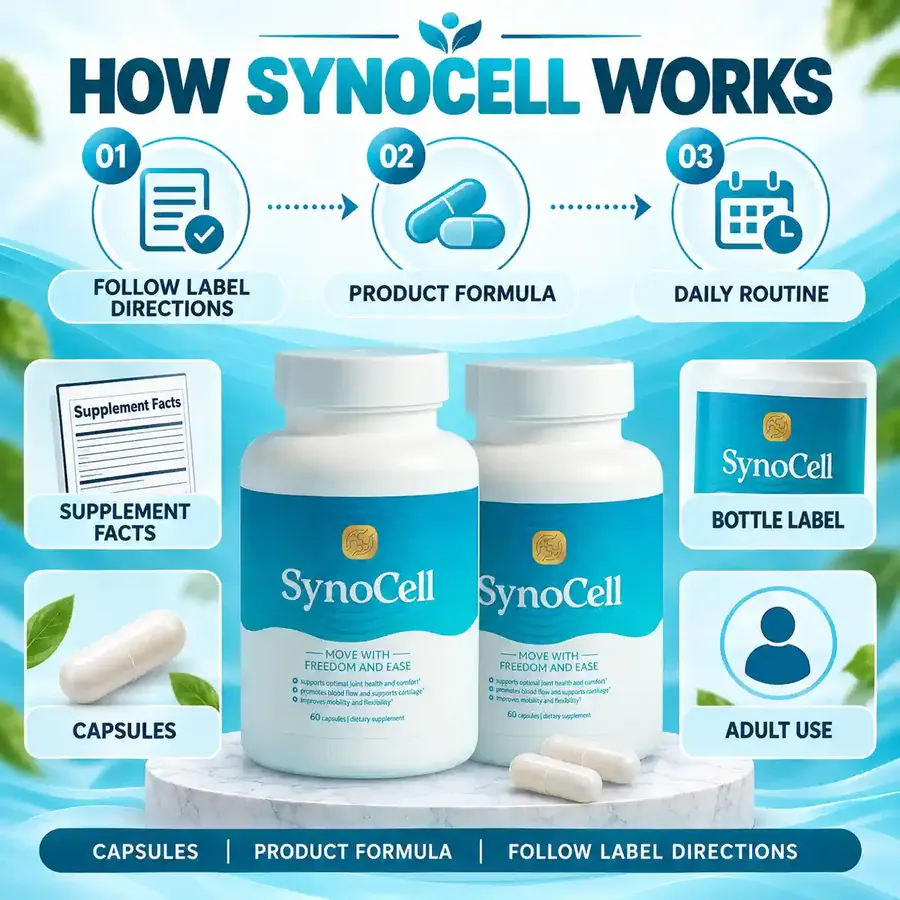
Pick a pack. Two capsules a day, and the 90-day money-back policy gives you three months to decide.
- Secure checkout
- 90-day money-back policy
- Ships from the U.S. with tracking