Ingredient research
Avocado soybean unsaponifiables (ASU): what the research really shows
ASU is an oil extract from avocado and soybean. In four trials with 651 people, it lowered pain by about 8.5 points on a 0-100 scale, a small benefit of questionable importance (Cameron and Chrubasik, 2014). A 3-year hip trial found no slowing of joint damage (Maheu et al., 2014 (ERADIAS)). SynoCell lists 310 mg, close to the 300 mg used in studies.
Written by the SynoCell editorial teamUpdated · 8 min read
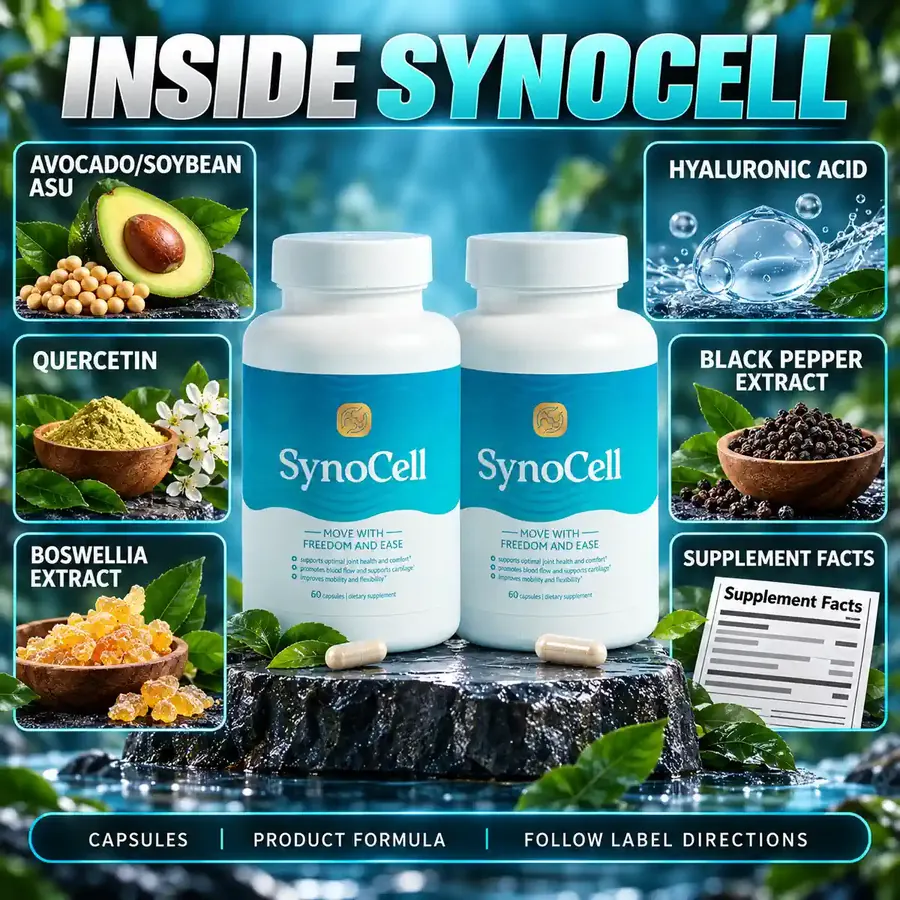
What is ASU, and why is it in SynoCell?
ASU stands for avocado/soybean unsaponifiables. It is the small part of avocado and soybean oil that does not turn into soap when the oil is processed.
In France, a version called Piascledine has been studied for knee and hip osteoarthritis. Most trials gave 300 mg a day (Cameron and Chrubasik, 2014).
SynoCell lists 310 mg of ASU in each 2-capsule serving. That is the first line on the brand's Supplement Facts and the largest amount on the label, tied with quercetin. You can see every line on our Supplement Facts guide.
How does SynoCell's ASU dose compare with the trials?
Very closely. The label gives 310 mg a day; the trials used 300 mg a day.
Many joint products hide amounts inside a proprietary blend. SynoCell does not. For ASU, the printed amount sits right next to the research dose (Cameron and Chrubasik, 2014) (WebMD, Avocado soy unsaponifiables).
What did the Cochrane review find about ASU?
It found a small drop in pain. The 2014 review of oral herbal therapies looked at four ASU trials with 651 people. Everyone had osteoarthritis. Here is what it reported (Cameron and Chrubasik, 2014):
- ASU at 300 mg a day lowered pain by about 8.5 points on a 0-100 scale compared with placebo.
- The reviewers called this a small benefit of questionable clinical importance.
- They rated the evidence as moderate quality, so new trials could still change the picture.
- ASU had no meaningful effect on joint space width, the gap between bones seen on X-rays.
- No serious side effects were linked to the herbal products reviewed, though safety data were limited.
The NIH's complementary health center agrees: slight improvements that patients might not find meaningful (NCCIH, Osteoarthritis In Depth).
What does a small benefit on a 0-100 pain scale mean?
It means relief many people would barely notice day to day. Trials ask you to mark pain on a line, where zero is none and 100 is the worst imaginable.
A drop of about 8.5 points is less than a tenth of that line (Cameron and Chrubasik, 2014). It is an average, too. Some people in the trials did better and some did no better than placebo.
A plain way to picture it
Think of a knee that makes the stairs hard. A small benefit might mean the stairs feel a little easier on some days. It does not mean the knee feels new. If you expect that, ASU will disappoint you.
Compare that with weight loss: each pound lost takes about four pounds of load off the knee (Messier et al., 2005).
Did ASU slow hip arthritis in the 3-year ERADIAS trial?
No, not on average. ERADIAS was a long, careful trial. It tested whether ASU could slow the narrowing of the hip joint over time (Maheu et al., 2014 (ERADIAS)).
| Question | Cochrane review | ERADIAS hip trial |
|---|---|---|
| Who was studied | 4 trials, 651 people with osteoarthritis | 399 people with hip osteoarthritis |
| Dose | 300 mg a day | 300 mg a day (Piascledine) |
| How long | Varied by trial | 3 years |
| Pain | About 8.5 points lower on a 0-100 scale | No different from placebo |
| Joint space | No meaningful effect | Average loss about the same: -0.638 mm vs -0.672 mm |
| Bottom line | Small benefit of questionable importance | Clinical relevance unclear |
One finding looked better: fewer people on ASU were classed as "progressors", 40% versus 50% on placebo (Maheu et al., 2014 (ERADIAS)). Pain, function and painkiller use did not differ.
So the brand store's line that SynoCell "speeds joint healing" or restores cushioning goes well past this evidence. No trial shows ASU rebuilding cartilage.
Try SynoCell with a 90-day window2 capsules a day · from $39 a bottle · free standard U.S. shipping
Order nowIs ASU safe to take every day?
For most adults, it appears to be. ASU is usually well tolerated, and adults have most often used 300 mg daily for up to 3 years (WebMD, Avocado soy unsaponifiables).
Long-term use
Trials ran up to 3 years at 300 mg a day without serious safety signals (Maheu et al., 2014 (ERADIAS)) (WebMD, Avocado soy unsaponifiables).
Soy allergy
ASU comes partly from soybeans, and soy is a common food allergen (MedlinePlus, Food allergy). Check with your clinician before you start.
Pregnancy and nursing
Reliable information is lacking, so avoid ASU while pregnant or breastfeeding (WebMD, Avocado soy unsaponifiables).
SynoCell is a blend, though. Quercetin and black pepper extract can change how some medicines work, so ask your pharmacist first if you take a daily prescription. See our side effects page.
Where does ASU fit in a plan for sore knees or hips?
As an optional extra, not the base. The American College of Rheumatology's 2026 guideline summary strongly recommends exercise, weight loss for people who are overweight, and NSAID creams or pills (ACR, 2026 OA guideline summary). It does not address ASU either way.
Start with movement
Walking, strength work and water exercise have the strongest support for osteoarthritis (ACR, 2026 OA guideline summary).
Work on weight if needed
The 2019 guideline set a goal of at least 5% of body weight for knee and hip arthritis (Kolasinski et al., 2020 (ACR/AF 2019 guideline)).
Add a supplement if you want
Give ASU a steady trial and track stairs and walks. See our knee pain guide.
A joint that turns suddenly hot, red and swollen, or pain with a fever, is a different matter. That needs urgent care, since it can mean infection (MedlinePlus, Septic arthritis).
Is the ASU in SynoCell worth it?
It is a fair dose of an ingredient with a small, real-but-modest effect on pain. It will not change your X-rays, and no trial has tested SynoCell's full blend. Compare it with Boswellia.
FAQ
Questions people ask about ASU
Is avocado soybean unsaponifiables worth taking for knee pain?
It may help a little. A Cochrane review of four trials found pain about 8.5 points lower on a 0-100 scale, which the authors called a small benefit of questionable clinical importance. Exercise and weight loss have stronger support, so ASU works best as an extra, not a replacement (Cameron and Chrubasik, 2014).
How much ASU per day was used in studies?
Most studies used 300 mg of ASU a day, usually the French product Piascledine. Adults have taken that amount for up to 3 years. SynoCell lists 310 mg in a 2-capsule serving, which is very close to the research dose, so the amount itself is fair (WebMD, Avocado soy unsaponifiables).
Can ASU slow hip arthritis on X-rays?
Not on average. In the 3-year ERADIAS trial, 399 people with hip osteoarthritis took ASU or placebo. Joint-space loss was about the same in both groups, and pain and function did not differ. The authors called its clinical relevance unclear (Maheu et al., 2014 (ERADIAS)).
Is ASU safe if I am allergic to soy?
Ask your clinician first. ASU is made partly from soybean oil, and soy is one of the common food allergens that can cause serious reactions. Nobody has published how much soy protein, if any, remains in SynoCell's ASU, so a professional should weigh the risk with you (MedlinePlus, Food allergy).
How many weeks should I try ASU before judging it?
There is no exact answer, and the brand publishes no timeline. ASU trials ran for months, not days. A steady trial of several weeks, with notes on stairs and walks, is the fairest way to judge it. Stop and talk to your doctor if your joints get worse.
Does ASU have side effects?
It is usually well tolerated. Adults have used 300 mg daily for up to 3 years in studies without serious safety signals, though safety data are limited. Pregnant and breastfeeding women should avoid it because reliable information is lacking (WebMD, Avocado soy unsaponifiables).
Who wrote this
Written and reviewed by
Plain-language pages built from the label, the brand store and linked medical sources.
Last updated . Read our editorial standards and how we check reviews. This website is run by an authorized U.S. retailer, not by the manufacturer. We earn money when you buy through our order links.
Keep reading
More about SynoCell
ASU
310 mg of ASU per serving, near the trial dose. Small pain benefit, no proof of cartilage protection.
Read more
Supplement Facts
Every line of the SynoCell label, what is missing from it, and how to read any Supplement Facts panel.
Read more
Boswellia for knee pain
5-Loxin, Aflapin and SynoCell's 65% extract: what Boswellia trials found and how long to give it.
Read moreUSA authorized SynoCell retailer
Ready to try SynoCell?
Pick a pack. Two capsules a day, and the 90-day money-back policy gives you three months to decide.
- Secure checkout
- 90-day money-back policy
- Ships from the U.S. with tracking